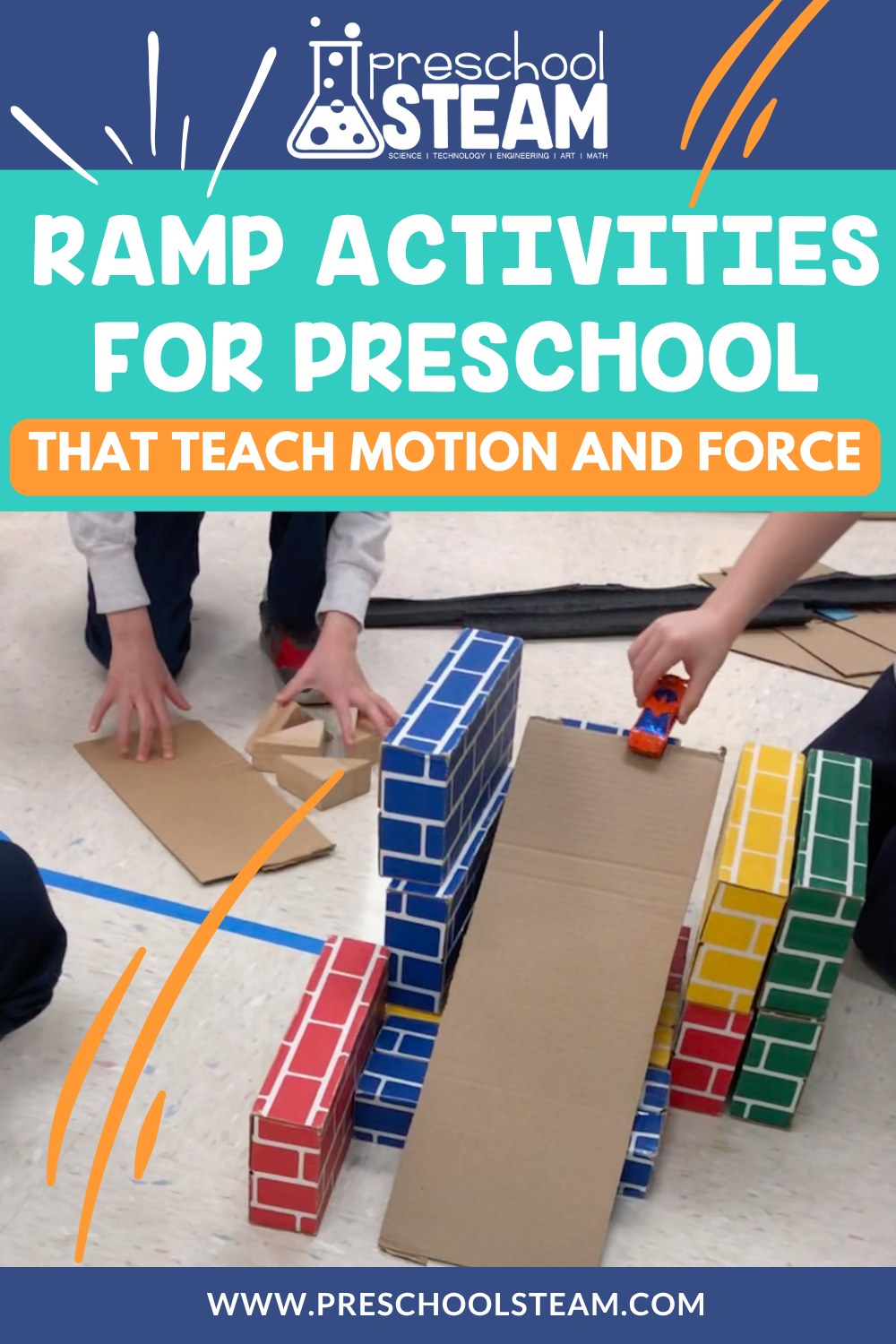
Ramps show up in preschool classrooms all the time.
With blocks.
With cars.
With anything that rolls.
And children don’t need instructions.
They push.
They drop.
They watch what happens.
That’s your starting point.
Why Movement Is a Natural STEAM Experience
Children are constantly exploring motion.
What rolls fast
What stops
What crashes
They’re testing:
- Speed
- Force
- Direction
- Cause and effect
You don’t need to introduce it.
They’re already doing it.
Start With What They’re Already Doing
Before setting up a “ramp activity,” pause.
Watch.
What are they doing with objects?
Rolling cars down blocks
Dropping balls from different heights
Stacking and knocking things over
That’s experimentation.
Simple Ramp STEAM Ideas That Build Thinking
You don’t need a perfect ramp setup.
You need small shifts.
🛝 1. Change the Angle
- What happens when it’s steeper?
- Does it go faster or slower?
Now you’re exploring speed and motion.
🛝 2. Try Different Objects
- What rolls?
- What slides?
- What doesn’t move at all?
Now you’re comparing properties.
🛝 3. Test Distance
- Which one goes farther?
- Why did that stop sooner?
Now you’re measuring and predicting.
🛝 4. Let Them Build Their Own
Instead of setting it up:
Give them:
- Blocks
- Boards
- Tubes
Let them design.
That’s engineering.
Let the Play Become the Experiment
You don’t need to direct it.
You need to extend it.
Ask:
What do you think will happen?
Why did that go faster?
What could we change?
That’s where thinking deepens.
Where STEAM Naturally Happens
Movement connects to everything:
Science → motion and force
Technology → using simple tools to test and explore motion
Math → distance and comparison
Engineering → building and testing
Art → design and structure
All from something they’re already doing.
A Simpler Way to Do Ramp STEAM
You don’t need a setup.
You don’t need a plan.
You need time to watch what children are already exploring.
Movement is already an experiment.
That’s where the learning lives.


Leave a Reply