Leprechaun traps can be one of the best STEM challenges of the year.
Or one of the most over-directed.
The difference isn’t the materials.
It isn’t the theme.
It isn’t even the tradition.
It’s how much thinking we leave to the children.
Leprechaun traps have the potential to be a meaningful preschool engineering activity. They invite children to design, test, and solve problems.
But sometimes the focus quietly shifts from engineering… to decorating.
The goal becomes:
“Make it cute.”
“Make it look like this.”
“Follow these steps.”
And the problem-solving thinking gets smaller.
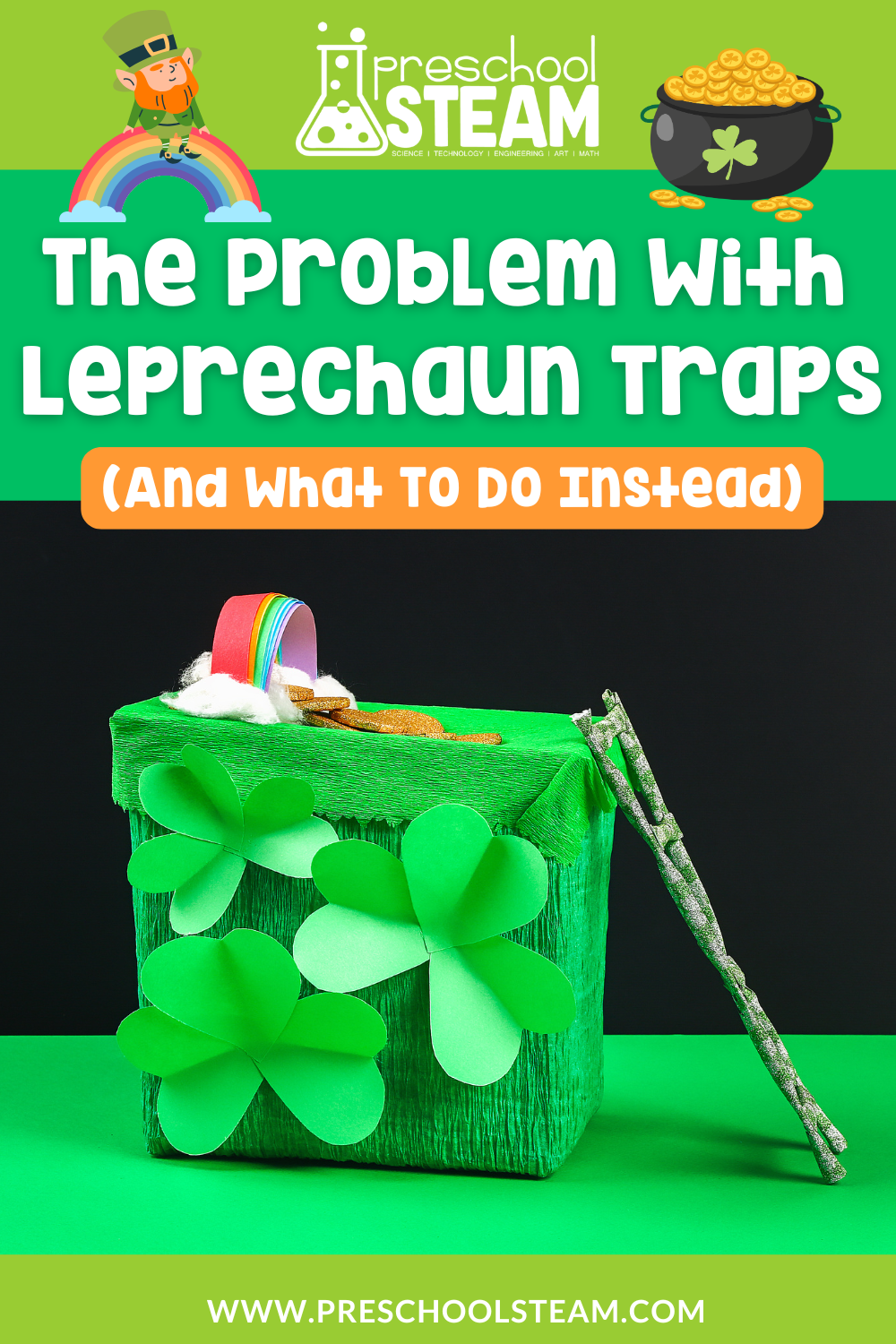
The Real Goal of a Leprechaun Trap STEM Challenge
The goal isn’t to build a box with glitter.
The goal is to solve a problem.
How could you trick something into stepping somewhere?
What would make something fall?
How could you make a structure stable?
That’s engineering.
If there isn’t a real problem to solve, it turns into crafting.
Using Books to Launch a Leprechaun Trap STEM Activity
Books are a powerful way to introduce the challenge.
The Night Before St. Patrick’s Day by Natasha Wing is one example that shows characters imagining and designing traps.
After reading, don’t show a finished example.
Instead, ask:
- What did they try?
- Why do you think it worked?
- What would you try?
Now the idea belongs to the children.
How to Run a Leprechaun Trap STEM Challenge in Preschool
Instead of:
“Build this kind of trap.”
Try:
5-Star STEAM Challenge:
Design a structure that could catch a leprechaun.
Then provide open-ended materials:
- Cardboard boxes
- Tubes
- Tape
- String
- Recycled materials
- Loose parts
No template.
No sample model.
Just materials and time.
The Teacher’s Role in a Preschool Engineering Challenge
This is where the learning deepens.
Your job isn’t to fix it.
It’s to ask:
- What’s your plan?
- What might make it stronger?
- What will happen if you change that?
- How will you test it?
Resist solving problems for them.
Engineering grows in the struggle.
Why Testing and Redesign Matter in STEM Activities for Preschool
The richest STEM learning happens when the traps stay out.
Let children:
- Test their designs.
- Adjust what didn’t work.
- Strengthen weak points.
- Redesign over several days.
When we allow revision, we move from crafting to real engineering.
Rethinking Leprechaun Traps as a Meaningful STEM Activity
Leprechaun traps aren’t the problem.
Over-direction is.
When we focus on the problem-solving instead of the decoration, we create:
- Deeper thinking
- Real experimentation
- Meaningful STEAM
If you’re planning leprechaun traps this March, keep them.
Just protect the engineering.
Give them the problem.
Give them materials.
Step back.
That’s where the learning lives.


Leave a Reply